

Organic French Fries and the Shift Toward Sustainable Potato Systems
Organic French fries represent a sustainable evolution in the beloved comfort food, crafted from potatoes cultivated without synthetic pesticides, herbicides or fertilizers, adhering to strict organic standards that prioritize soil health, biodiversity, and consumer well-being. As processed potatoes dominate global snack markets with frozen French fries alone valued at USD 23.5 billion the organic segment is surging, driven by health conscious consumers seeking cleaner alternatives amid rising concerns over chemical residues and environmental degradation.
In regions like North America, where the U.S. French fries market is projected to reach USD 8.53 billion by 2032, organic options appeal to millennials, who prioritize eco-friendly and nutritious foods, boosting demand in quick-service restaurants and retail. The growing demand for organic French fries is fueled by health trends emphasizing low-fat and nutrient-rich snacks, sustainability initiatives like regenerative farming and eco-conscious consumer choices that favor products with minimal environmental impact, as evidenced by a 30% increase in demand for healthier variants over recent years.
Yet, producing organic French fries demands innovative farming and processing to maintain crisp texture and flavor without conventional additives, transforming a simple side dish into a symbol of regenerative agriculture. These innovations aim to minimize chemical inputs reducing pesticide use by up to 50% in some trials while boosting resilience in diverse climates, from arid African soils to temperate European fields.
For instance, drone-based precision applications in the Netherlands have cut chemical runoff by 30-40%, promoting biodiversity and soil health. As global potato production approaches 400 million tons annually, these developments are pivotal in addressing rising demands driven by population growth and urbanization.
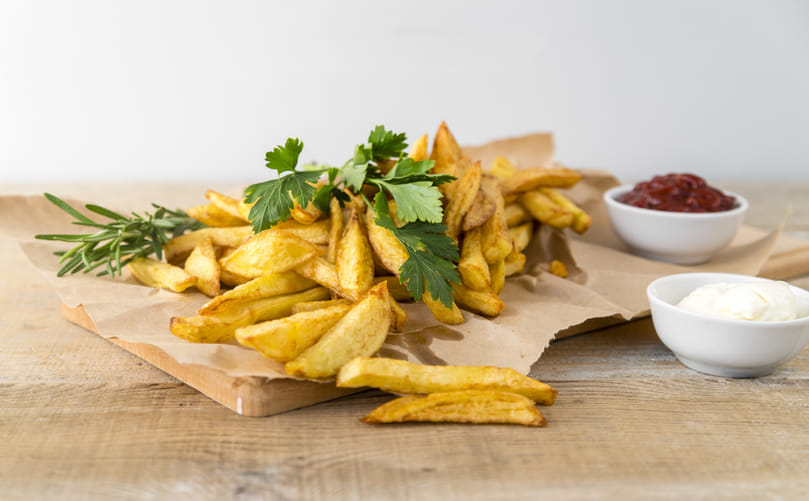
Organic French Fries Made from Certified Organic Potatoes
What Are Organic French Fries?
Definition: Organic French fries are deep-fried or baked potato strips derived from tubers grown under certified organic protocols, free from genetically modified organisms (GMOs), synthetic chemicals and irradiation, as regulated by bodies like the USDA's National Organic Program (NOP). Production involves washing, cutting, blanching and frying in organic oils (e.g., sunflower or canola), often par-fried and frozen for convenience, ensuring minimal processing to retain nutritional integrity. Unlike conventional fries, which may use chemical preservatives, organic versions emphasize natural flavors and textures, with varieties like crinkle cut or shoestring tailored for retail or foodservice.
Purpose: These fries serve to deliver a healthier fast-food staple, mitigating risks from agrochemicals while supporting sustainable farming that enhances soil fertility and biodiversity. They cater to the growing demand for clean-label products, with the organic frozen fries segment projected to grow at 4.2% CAGR through 2033, driven by health trends and premium pricing.
History and Origins of Organic French Fries
The story of organic French fries traces back to the potatoes ancient Andean roots around 8,000 years ago, where indigenous farmers practiced polyculture intercropping potatoes with beans and quinoa to naturally deter pests, laying the groundwork for organic principles. Introduced to Europe in the 16th century, potatoes faced suspicion until Antoine-Augustin Parmentier's 18th-century advocacy turned them into a staple, with frying emerging in Belgium or France by the late 17th century as a preservation method during harsh winters.
The organic movement gained traction in the 1970s amid environmental awakenings, with pioneers like Alice Waters championing chemical-free farming. Commercial organic potato processing began in the 1990s in the Netherlands, where production hit 3.5 million tons of organic fries amid EU bans on certain pesticides. In the U.S., the 2002 USDA National Organic Program certification spurred growth but scaling for fries lagged due to yield gaps. Family operations have transitioned thousands of acres to organic, launching lines and marking milestones in mainstream adoption.
Production Techniques in Organic French
Fries Organic French fry production blends traditional craftsmanship with eco-conscious methods, starting with certified seeds planted in soil amended with compost and manure, avoiding synthetic inputs. Cultural practices like crop rotation every 3-4 years disrupt pests, while biological controls such as releasing predatory nematodes for wireworms replace chemical fumigants. Harvested tubers are sorted for blemish-free quality, then peeled via steam (not caustic soda) to preserve nutrients, cut into uniform strips and blanched in hot water with organic citric acid to prevent browning.
Processing culminates in par-frying in expeller-pressed oils at 177°C, followed by flash-freezing at -40°C for crispness upon reheating. Innovations like vacuum frying reduce oil absorption by 20%, enhancing shelf life without additives. In the Netherlands, drone-monitored fields optimize irrigation, cutting water use by 25% while maintaining NOP compliance.
Importance and Benefits of Organic French Fries
Organic French fries are vital for bridging indulgence and health, offering a lower-acrylamide alternative formed during high-heat frying a gentler processing that cuts levels by 40% . They support biodiversity by fostering pollinator habitats in organic fields, reducing erosion and sequestering carbon at rates 20% higher than conventional farms . The growing demand for organic French fries is driven by health trends, with over 20% of consumers preferring organic options for reduced chemical exposure and higher nutrient retention, as seen in a 30% rise in demand for healthier fries in recent years .
Sustainability plays a key role, with eco-conscious choices favoring responsibly sourced products that minimize environmental impact, supported by initiatives like eco-friendly packaging and reduced carbon emissions . This demand is projected to contribute to the frozen French fries market 10.8% CAGR through 2032, with organic and sustainably sourced variants gaining traction among millennials and Gen Z .
Yield and Quality Impact: While organic yields lag 20-30% behind conventional due to natural pest pressures, premium pricing often 50% higher yields net returns up to 35% greater, as in Washington State University trials . Biofortified varieties enhance nutrition, with higher vitamin C retention in processed fries.
Health and Environmental Benefits: Free from residues linked to endocrine disruption, they promote safer consumption, with studies showing no causal ties to weight gain when moderated . Environmentally, they lower water pollution from runoff, preserving aquatic life.
Economic Advantages: The segment drives USD 12 billion in IPM-like benefits globally, with U.S. organic sales growing 12% annually .
Challenges in Organic French Fries
Organic production faces hurdles like pest vulnerabilities e.g., Colorado potato beetles thriving without neonicotinoids leading to 10-20% crop losses, as in East African highlands . Certification costs, averaging USD1,500 annually per farm, burden smallholders, with only 10% of global potato acreage organic.
Resistance and Efficacy: Pathogen strains like late blight evolve faster in chemical-free systems, demanding vigilant rotations and biopesticides like Trichoderma, which can raise labor by 15% .
Regulatory and Supply Pressures: European Union s stringent residue limits complicate imports, while climate shifts warmer soils accelerating aphid vectors exacerbate outbreaks.
Major Market Regions for Organic French Fries
The organic French fries market is largely shaped by regions with strong consumer awareness of health, sustainability and organic food standards. Although organic fries remain a niche within the broader frozen potato sector, their growth rate consistently outpaces that of conventional products, particularly in developed economies with mature retail and foodservice infrastructure.
North America is the leading market, accounting for approximately 35–45% of global organic French fries consumption. The United States dominates this region due to high penetration of organic foods in retail, the expansion of private-label organic products and growing demand from health-conscious consumers, especially millennials and Gen Z. Organic French fries are increasingly present in fast-casual and premium foodservice outlets, while retail sales continue to drive overall volume growth.
Europe represents the second-largest market, contributing roughly 25–30% of global demand. Strong regulatory frameworks under EU organic certification, combined with high consumer trust in organic labels, support steady market expansion. Countries such as Germany, the United Kingdom, France and the Netherlands lead consumption and processing. Europe’s emphasis on sustainability, traceability and environmental responsibility has reinforced organic French fries as a premium yet increasingly mainstream product.
The Asia–Pacific region is the fastest-growing market, currently accounting for about 15–20% of global consumption. Rapid urbanization, rising disposable incomes and changing dietary habits are driving demand for frozen and convenience foods. Growth is particularly strong in China, Japan, Australia and South Korea, where organic French fries are positioned as premium, health-oriented imports or specialty retail products. India shows early-stage growth, primarily in metropolitan markets.
In Latin America, organic French fries remain an emerging segment, representing approximately 5–8% of global consumption. Countries such as Brazil and Argentina are witnessing gradual growth supported by expanding fast-food chains, improving cold-chain infrastructure and increased organic potato cultivation aimed at both domestic use and export markets.
The Middle East and Africa account for a smaller share, estimated at 3–5%, with demand concentrated in high-income urban centers and tourism-driven markets. The United Arab Emirates and South Africa lead the region, where organic French fries are mainly consumed in premium retail outlets, hotels and international foodservice chains catering to expatriates and tourists.
Overall, these regional patterns highlight a broader shift toward organic and sustainably produced foods within the global frozen French fries market, valued at over USD 25 billion. While organic French fries currently represent a limited share by volume, their faster growth, premium pricing, and alignment with health and sustainability trends position them as an increasingly important segment of the global potato industry.
Leading Organic French Fries Producers
The organic French fries market is led by a mix of established brands and innovative processors focused on certified organic sourcing. Key players include:
Cascadian Farm Organic: Founded in 1972 and headquartered in Maine, USA, this pioneer in organic frozen foods (now under General Mills) specializes in a range of organic potato products, including straight-cut and seasoned French fries, emphasizing regenerative farming and non-GMO ingredients. It holds a significant share in the U.S. retail organic segment.
Alexia Foods: A premium brand known for organic and all-natural frozen fries, Alexia (acquired by Conagra Brands) offers varieties like sweet potato and olive oil-seasoned fries, targeting health-focused consumers with low-sodium and gluten-free options.
Hudson River Foods: Based in upstate New York since 2005, this co-manufacturer produces organic, non-GMO French fries for private labels and brands, with a focus on vegan and allergen-free products using locally sourced potatoes.
Northern Girl: Operating from Maine, this family-run processor offers certified organic French fries alongside other root vegetables, prioritizing small-batch production for freshness and sustainability.
Idaho Natural & Organic Foods (INAOF): Located in Idaho, a hub for potato production, INAOF manufactures organic frozen fries and appetizers, leveraging the region's high-quality organic potato yields for foodservice and retail.
Larger conglomerates like McCain Foods and Lamb Weston also offer organic lines, but the niche is dominated by these specialized organic-focused entities, which collectively drive innovation in clean-label processing.
Innovations and Future Outlook
Innovation in organic French fry production is increasingly centered on regenerative agriculture, precision technologies and cleaner processing methods. Many organic potato growers are adopting cover cropping systems such as legumes and grasses to improve soil organic carbon, suppress weeds, and reduce greenhouse gas emissions. Long-term trials indicate that regenerative practices can lower net emissions by up to 20–30% while improving soil water-holding capacity and resilience to drought.
In processing, product design innovation is reshaping consumption patterns. Air-fryer optimized fry cuts and coatings derived from natural starches allow up to 40–50% reduction in oil absorption, meeting consumer demand for healthier preparation methods without compromising texture or taste. Advances in blanching temperature control and rapid freezing further enhance quality while minimizing acrylamide formation.
Digital agriculture is playing a growing role in organic systems. AI-driven disease forecasting models, combined with weather data and field sensors, enable early warning of late blight, aphids, and other major threats often 3–5 days in advance. This allows timely deployment of biological controls and cultural interventions, reducing crop losses by up to 20–25% in some pilot programs.
Packaging and processing automation are also evolving. By 2030, the integration of biodegradable or compostable packaging, robotic optical sorters, and energy-efficient freezing lines is expected to become standard across premium frozen potato segments. These technologies align organic French fries with circular economy goals while improving consistency and reducing post-harvest waste. Collectively, such innovations position organic fries to capture a growing share of the global frozen potato market, projected to exceed USD 34 billion in the coming decade.
Global Impact and Role in Food Security
Organic French fries are part of a broader potato-based food system that supports the diets and livelihoods of over one billion people worldwide. While fries themselves are a processed product, the expansion of organic potato farming contributes to safer food chains, reduced chemical exposure and long-term soil productivity especially important in regions with fragile ecosystems.
In parts of Africa and Asia, organic and low-input potato systems integrated with Integrated Pest Management (IPM) and biofortified varieties are helping address micronutrient deficiencies and stabilize yields under climate stress. These systems often improve farm resilience rather than maximizing short-term output, supporting food security where access to synthetic inputs is limited or costly.
From a climate perspective, organic potato systems reduce reliance on synthetic fertilizers and pesticides, lowering indirect greenhouse gas emissions and protecting water resources. Improved soil structure and organic matter enhance carbon sequestration and buffer crops against extreme weather events, helping secure potato supplies amid increasing climate volatility.
Economically, organic and sustainably produced potato products are strengthening regional value chains and rural employment. North America currently leads adoption and market share, driven by consumer demand and institutional sustainability commitments, but growth is accelerating globally as food systems transition toward resilience, transparency, and environmental accountability.